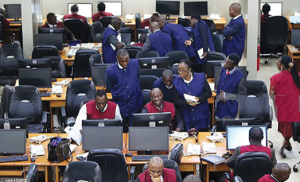
On the morning of May 30, 2023 — one day after Bola Ahmed Tinubu was sworn in as Nigeria’s 16th president — investors flooded the floor of the Nigerian Exchange (NGX) with buy orders.
Other News
Stocks surged 5.23% in a single session, adding N1.5 trillion in market value before the closing bell.
Three years on, the bull is still running. As of May 26, 2026, the All-Share Index stood at 249,738.8 points, with total market capitalisation at N160.09 trillion and a year-to-date return of 60.49% — representing a 348% gain from the 55,769.28 points and N30.38 trillion market cap recorded when Tinubu was inaugurated.
By every conventional measure, this is the most impressive three-year capital market performance under any civilian administration since Nigeria’s return to democracy in 1999.
What the data is saying
The numbers form a staircase of records. The NGX closed 2023 with a 45.9% gain in the All-Share Index — the best return since the 50% surge in 2020, and the ninth most successful year in the exchange’s 39-year history.
- The market opened 2024 as the world’s best-performing stock market in the first three weeks of January, reaching 94,538.12 points with a 26.43% year-to-date return, before closing the full year at 37.65%.
- Then 2025 arrived and rewrote the record books entirely. The NGX All-Share Index closed 2025 at an unprecedented 155,613.03 points — a 51.19% full-year return that cemented Nigeria’s position as the best-performing emerging and frontier market exchange globally, against the MSCI All Country World Index’s roughly 20% gain.
- It was the best performance for Nigerian stocks in about 18 years, second only to 2007’s 74.74% gain, with only 2020, 2013, and 2023 coming anywhere close in modern memory.
- 2026 has not relented. On May 25, 2026; four days before the third anniversary, the ASI reached 251,125.0 and market capitalization rose to N160.9 trillion, with year-to-date returns at 61.38%.
NGX Group Chairman Umaru Kwairanga captured the full scale at the Africa Capital Forum in London in March 2026: the ASI had risen from 55,808 to over 200,000 points — a 261% increase — while market capitalisation grew from N30.38 trillion to N129.32 trillion, a 325% surge, with trading volumes and value also increasing fourfold.
More insights:
According to Tajudeen Olayinka, CEO of Wyoming Capital Partners Limited, the rally did not begin on inauguration day but much earlier when investors started anticipating a market-friendly administration.
- “When the market saw that the three leading candidates in 2022 — Peter Obi, Atiku Abubakar, and Tinubu — were pro-market, the market started reacting,” he told Nairametrics.
- “Even when the election had not taken place, the market was forward-looking. Market started pricing in those likely positive impacts on stock prices.”
- “Buhari centred his own around the public sector. He wanted the government to be the driver of everything. But this administration is private-sector-focused.”
- “The 5.23% single-day surge on May 30, 2023, was the release of months of accumulated bullish sentiment that had been building since investors realised a market-friendly administration was coming.”
Olayinka explained that investors interpreted the incoming administration’s policy direction as one that would shift economic activity toward the private sector, thereby strengthening equities and broader financial markets.
Expert views:
Analysts say the market rally has been underpinned by a series of difficult but consequential economic reforms introduced by the Tinubu administration.
- Fuel subsidy removal, foreign exchange liberalization, and CBN monetary policy reforms have been identified by Nairametrics as the three structural drivers of the rally.
- According to the IMF, Nigeria’s economic growth accelerated to 4.1% from 3.3% when Tinubu assumed office, while Moody’s Ratings and Fitch upgraded Nigeria’s credit ratings in 2025.
- “Most foreign investors who wanted to exit found it difficult to leave. This government settled those contracts. They needed to stabilize the market, create liquidity, and gradually revive the economy,” Olayinka explained.
- “Anybody that is going to address imbalance in an economy must run an adjustment programme. There is no way you can escape it,” he added.
Chief Blakey Okwudili Ijezie, founder of Okwudili Ijezie & Co. (Chartered Accountants), however, noted that the market’s performance tells only one side of Nigeria’s economic story.
The paradox of confidence and hardship:
While investors benefited from soaring asset prices, many Nigerians faced worsening economic conditions triggered by inflation and rising living costs.
- “Markets often tell only one side of a nation’s story,” Chief Ijezie told Nairametrics. “While the market advanced, the lived experience of many Nigerians became increasingly difficult.”
- “Energy costs rose sharply. Small businesses struggled under rising operating expenses. Insecurity continued to weigh heavily on farming communities and productive rural economies.”
- “The market today is, in many respects, stronger than the emotional and economic reality of the average Nigerian citizen.”
- “Capital markets are forward-looking institutions. They price tomorrow before society experiences tomorrow,” he added.
Olayinka agreed that the adjustment programme created a divided economy where investors with assets were able to hedge through equities and real estate, while lower-income Nigerians absorbed the full weight of inflationary reforms.
Way forward:
Both analysts argued that sustaining the market’s momentum will require broader economic reforms capable of translating financial gains into real sector growth.
- Olayinka called for deeper private sector participation in infrastructure projects such as the Lagos-Calabar Coastal Highway through public-private partnerships.
- “When you say you are doing an adjustment programme, privatisation is also part of it,” he said.
- “They still need experts either from the IMF or World Bank, or economists trained in running adjustment programmes,” Olayinka added.
- “Reforms alone do not build nations. Policy must translate into industrial expansion, stable electricity supply, manufacturing productivity, agricultural security, infrastructure growth, and renewed confidence in public institutions,” Ijezie stated.
The analysts warned that without stronger productive growth and improved security, the gains recorded in the stock market may remain disconnected from the realities faced by ordinary Nigerians.
What you should know:
Nigeria’s stock market performance under Tinubu significantly outpaces previous civilian administrations during the same period in office.
- Under former President Muhammadu Buhari, the market gained only 4.47% within a comparable three-year period.
- The closest historical benchmark remains the Olusegun Obasanjo administration, when the market recorded a 115% gain by July 2001.
- According to analysts, however, Obasanjo’s economic impact was more broadly felt across society, unlike the current period where reforms have imposed severe adjustment costs on households.
- “History will ultimately judge this period not by how high the market rose, but by whether reform translated into productive growth, improved security, institutional strength, and a better quality of life for ordinary citizens,” Ijezie said.
- “Because markets may rise on confidence. But nations rise on productivity, security, institutional strength, and the dignity of their people,” Chief Ijezie concluded.
Three years after the “TinuBULL” rally first emerged, the Nigerian stock market remains one of the strongest-performing exchanges globally. The larger question facing the Tinubu administration, however, is whether those gains on the trading floor can ultimately translate into meaningful improvements in the lives of ordinary Nigerians.