 Follow Us on Google Discover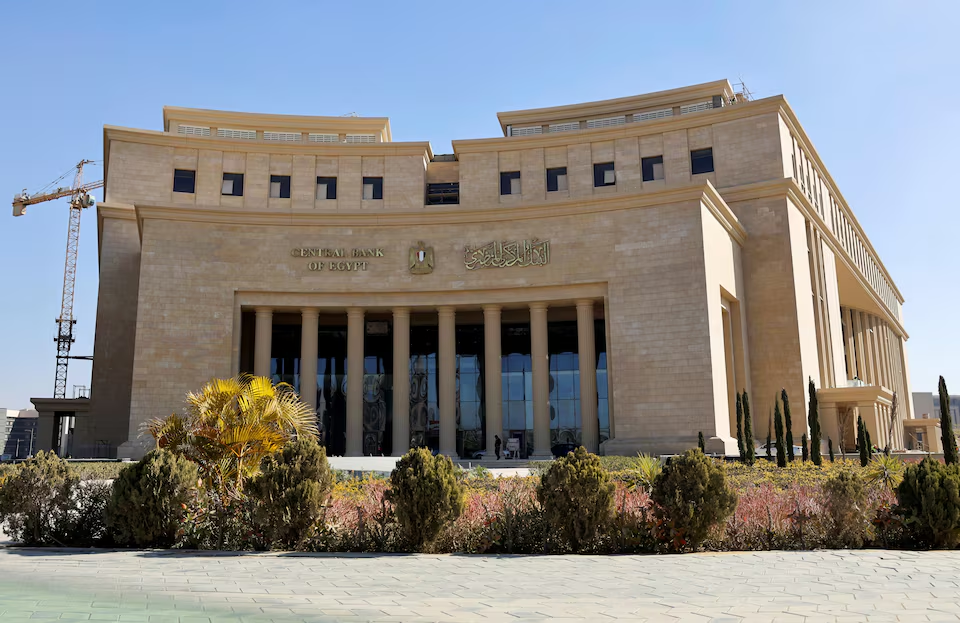
Egypt’s central bank has retained its benchmark interest rates, citing persistent inflationary pressures and growing external uncertainties linked to the ongoing geopolitical tensions in the Middle East.
The Monetary Policy Committee of the Central Bank of Egypt kept the overnight deposit rate unchanged at 19% and the lending rate at 20%, stating that the decision reflects its assessment of current and expected inflation dynamics amid an unfavorable external environment.
Reuters reported that the decision aligns with market expectations, as analysts had widely projected that Egyptian policymakers would maintain rates amid concerns that regional conflicts and global energy price shocks could fuel renewed inflationary pressures.
What Egypt’s central bank is saying
The Egyptian central bank said the decision to maintain rates was necessary to preserve monetary stability while closely monitoring inflation and broader macroeconomic conditions.
Also Read
The apex bank also warned that ongoing regional tensions could weigh on economic growth and inflation expectations in the near term.
- Egypt’s central bank stated that the decision reflects its assessment of current and expected inflation dynamics amid an unfavorable external environment.
- The bank noted that real GDP growth moderated to 5% in the first quarter of 2026, compared to 5.3% recorded in the fourth quarter of 2025.
- Policymakers also warned that growth could slow further in the second quarter due to the ongoing regional conflict involving Iran, Israel, and the United States.
- Analysts surveyed by Reuters had earlier projected that the central bank would likely keep rates unchanged because of concerns over rising inflation risks linked to geopolitical tensions.
The decision comes as several emerging economies continue to balance inflation control with slowing growth and rising external risks.
More insights
Recent inflation data in Egypt showed a slight moderation in price pressures, although inflation remains significantly above the central bank’s target range.
Annual urban consumer inflation eased unexpectedly to 14.9% in April 2026 from 15.2% recorded in March.
- Egypt’s inflation target remains between 5% and 9% by the fourth quarter of 2026.
- Core inflation, which excludes volatile food and fuel prices, declined to 13.8% in April from 14% in March.
- The overnight deposit rate was retained at 19%, while the lending rate remained at 20%.
- Economic growth slowed to 5% in Q1 2026 from 5.3% in the previous quarter.
Despite the moderation in headline and core inflation, policymakers remain cautious due to external inflationary risks, energy market volatility, and geopolitical uncertainties.
Nigerian context
Egypt’s decision mirrors broader trends across emerging markets where central banks are maintaining tight monetary conditions amid inflation concerns and external shocks.
In Nigeria, the Monetary Policy Committee (MPC) of the Central Bank of Nigeria recently retained the Monetary Policy Rate (MPR) at 26.5% following its 305th meeting.
- Nigeria’s headline inflation rose to 15.69% in April 2026 from 15.38% in March.
- The CBN also retained the Cash Reserve Ratio at 45% for commercial banks and 16% for merchant banks.
- The Standing Facilities Corridor was maintained at +50/-450 basis points around the MPR.
- Policymakers across emerging markets continue to adopt cautious monetary stances amid rising global uncertainties.
Analysts say central banks are increasingly prioritising inflation management and exchange rate stability as geopolitical tensions continue to disrupt energy and commodity markets.
What you should know
In April, the Central Bank of Egypt decided to maintain key policy rates, signaling a cautious approach to managing inflation while supporting economic growth.
Egypt’s economy has remained under pressure from elevated inflation, currency volatility, and external financing challenges over the past two years.
The latest decision highlights the difficult balancing act facing policymakers as they attempt to stabilise inflation without significantly undermining economic growth.

Olalekan Adigun is a seasoned political analyst and writer with extensive experience in crafting compelling narratives and executing strategic initiatives. Known for his insightful commentary on governance, policy, and socio-economic issues, he has contributed to various national and international platforms.