 Follow Us on Google Discover
Nigeria’s total external debt stock rose from $42.49 billion in December 2023 to $51.86 billion in December 2025, marking a $9.36 billion increase over two years.
This is as the Federal Government intensified foreign borrowing under President Bola Tinubu’s administration. The figures are based on the latest data published by the Debt Management Office (DMO).
The 22% increase reflects a major shift in Nigeria’s borrowing strategy away from reliance on bilateral creditors such as China and toward multilateral institutions, particularly the World Bank Group, alongside renewed access to international capital markets through Eurobond issuances.
The increase in external debt also comes at a time when the Federal Government is planning fresh World Bank loans estimated at $1.25 billion, even as concerns continue to mount over rising debt servicing costs and the country’s widening fiscal deficit.
Also Read
In terms of domestic debt, the administration has increased the figure from N59.1 trillion to N89.4 trillion.
However, over N22.79 trillion was the Ways and Means debt obtained during the Buhari administration, but capitalized as public debt in the Tinubu administration.
This suggests domestic debts grew on a net by about N7.5 trillion under this administration
This article, however, focuses on the external debt’s growth.
What the data is saying
Nigeria’s total external debt as of December 2025 stood at $51.86 billion, according to the latest DMO publication. The debt profile consists mainly of multilateral loans, bilateral loans, Eurobonds, and syndicated facilities from development finance institutions.
- Multilateral debts remain dominated by loans from the World Bank and the IMF, although Nigeria has fully repaid IMF obligations obtained under earlier emergency financing arrangements.
- World Bank exposure is split between the International Development Association (IDA) and the International Bank for Reconstruction and Development (IBRD).
- IDA loans increased from $14.96 billion in 2023 to $18.51 billion in 2025, while IBRD exposure rose from $485 million to $1.38 billion during the same period.
- Eurobond debt also climbed from $15.12 billion to $18.55 billion, representing an increase of more than $3 billion.
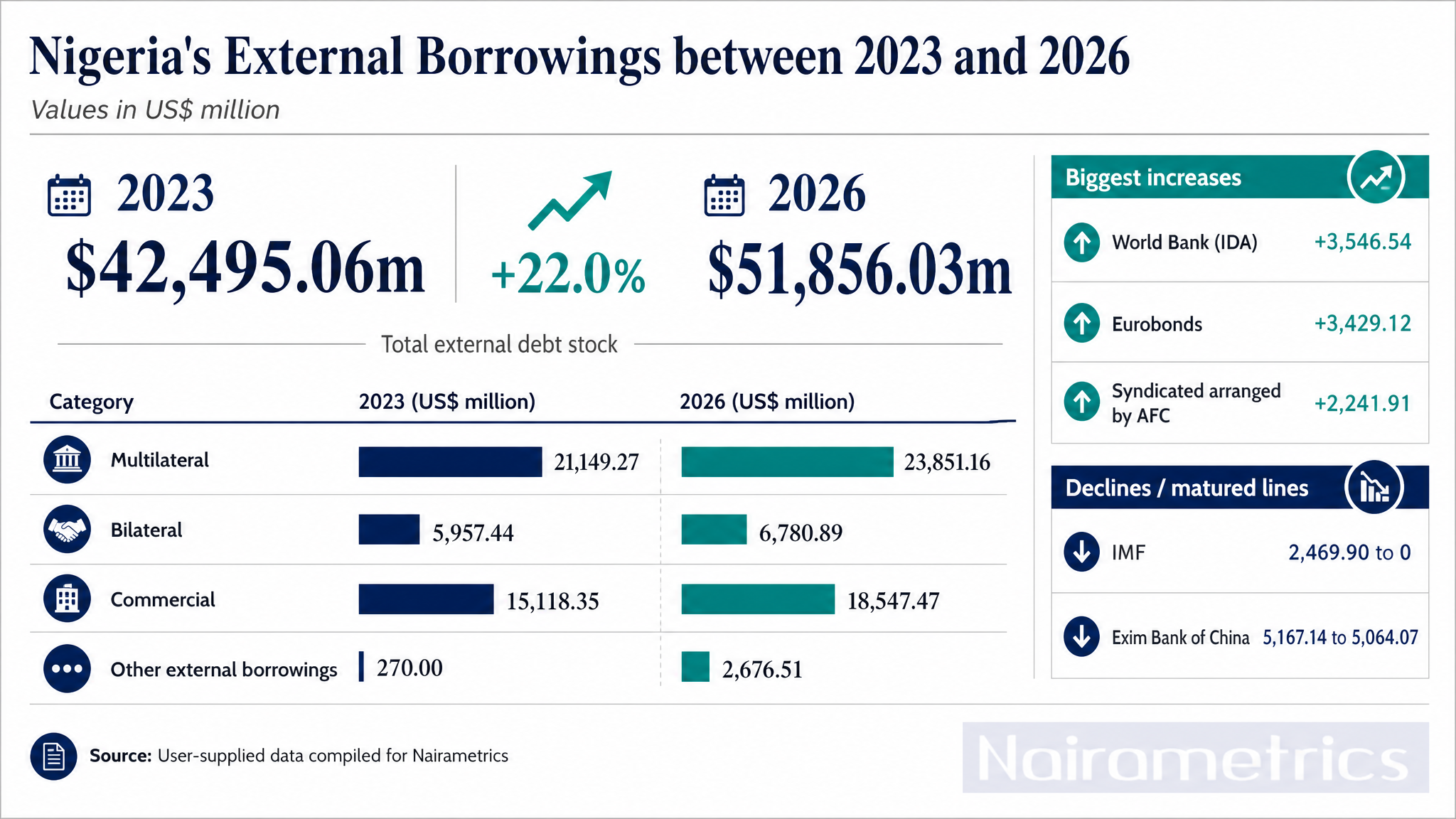
Meanwhile, loans from the African Development Bank rose from $3.2 billion to $3.9 billion, while bilateral loans increased from $5.9 billion to $6.7 billion, with China remaining one of Nigeria’s major bilateral creditors.
More Insights
The World Bank emerged as the biggest contributor to Nigeria’s external debt growth over the two-year period. IDA exposure alone expanded by $3.55 billion, while IBRD loans also recorded significant growth.
- The increase was driven by large policy-based financing approvals under the Tinubu administration, including the $2.25 billion RESET and ARMOR reform financing approved in June 2024.
- Another $1.57 billion was approved in September 2024 for the HOPE and SPIN programmes.
- In March 2025, the World Bank also approved $1.08 billion for education and resilience programmes.
- The flagship facility was the $1.5 billion Reforms for Economic Stabilisation to Enable Transformation (RESET) Development Policy Financing approved in June 2024.
Eurobond debt also surged following Nigeria’s return to the international capital market after years of limited activity.
- In December 2024, Nigeria issued a $2.2 billion dual-tranche Eurobond comprising $700 million at 9.625% due in 2031 and $1.5 billion at 10.375% due in 2034.
- In November 2025, another $2.35 billion dual-tranche issuance followed, consisting of $1.25 billion at 8.63% due in 2036 and $1.10 billion at 9.13% due in 2046.
- Investor appetite remained strong, with the November 2025 issuance attracting an orderbook of over $13 billion, representing a 477% oversubscription.
- The Africa Finance Corporation-arranged syndicated facility also rose sharply from $270 million to $2.51 billion.
Other contributors to the increase include a $524 million rise in African Development Bank loans, a new $517 million exposure from the China Development Bank, a $331 million increase from Agence Française de Développement, and a new $160 million facility from Unicredit.
However, exposure to China Exim Bank declined slightly as older facilities continued to amortize.
The Bigger Picture
The composition of Nigeria’s external debt has changed significantly over the past two years, with multilateral lenders and Eurobonds now accounting for the bulk of foreign obligations.
As of December 2025, World Bank loans represented 38.36% of Nigeria’s total external debt stock of $51.86 billion.
- External debt accounted for 47.3% of Nigeria’s total public debt stock.
- Domestic debt made up the remaining 52.7% of total obligations.
- Nigeria’s total public debt stock rose to N159.28 trillion, equivalent to $110.97 billion, as of December 2025.
- External debt service also increased to $5.21 billion in 2025 from $4.66 billion in 2024, representing an 11.9% year-on-year increase, according to Central Bank of Nigeria data.
While the government’s reform programme has attracted investor confidence, reflected in Moody’s upgrade of Nigeria’s rating from Caa1 to B3 and strong Eurobond demand, critics continue to express concerns over the pace of debt accumulation and the rising cost of servicing obligations.
What you should know
Nigeria has recorded a fiscal deficit every year since President Bola Tinubu assumed office in May 2023, continuing a trend that has persisted for more than two decades.
- The Federal Government increased its planned borrowing for 2026 to N29.20 trillion following an expansion of the proposed budget size and fiscal deficit.
- The revised borrowing plan represents an increase of N11.31 trillion compared to the earlier projection of N17.89 trillion contained in the 2026 Abridged Budget Call Circular issued in December 2025.
- Nigeria recorded a fiscal deficit of about N5.7 trillion in the first half of 2025 amid revenue shortfalls and elevated government spending.
- Fiscal deficit for 2024 rose sharply to N13.51 trillion, pushing the deficit-to-GDP ratio above the legal threshold allowed under the Fiscal Responsibility Act 2007.
Every fiscal deficit contained in the national budget represents fresh borrowing requirements for the government, suggesting that Nigeria’s total debt profile could continue to rise in the coming years, including through additional foreign loans.

The Research Team at Nairametrics meticulously monitors, gathers, curates, and administers an extensive repository of both macroeconomic and microeconomic data originating from Nigeria and across Africa. Utilizing a variety of presentation formats—including documents, tables, and charts—our analysts disseminate key findings through the Nairametrics platform. Additionally, we regularly release insightful, research-driven articles that offer in-depth analyses of economic trends and indicators.